


All Fish
A little colour. A whole lot of life.
279 products
Fish type


More about All Fish
Buying live fish online in Australia comes down to two worries.
The first one is obvious: will they actually arrive alive? The second one is quieter, and it costs people more money over a year — will the fish you picked still be getting along in three months, or will you be netting somebody out?
This page is the full freshwater list at Micro Aquatic Shop. Below it, a short guide to answering both questions before you add to cart.
Bred here, not flown in
Most of what you see on this page did not come off a plane. It was born about forty minutes west of Sydney’s CBD.
Our breeding room sits across two levels of our Wetherill Park warehouse and runs roughly 500 aquariums and grow-out tubs. Every one of them is checked, topped up and fed by hand, every day. Out of that room comes around 35 shrimp types, 25 Neocaridina lines, 25 Medaka varieties, 10 fancy guppy lines, 50 plant varieties and 10 mosses.
That matters for a practical reason rather than a romantic one. A fish raised in the same city you live in has already spent its life in water that is not wildly different from what comes out of your tap. It has not spent four days in a bag crossing a border. When it goes into your tank, the gap it has to bridge is small.
Everything is health-checked and packed with oxygen before it leaves, and every live order is covered by our Live Arrival Guarantee — it arrives alive and healthy, or we make it right.
Picking fish that will still get along in three months
Almost every stocking problem we get asked about traces back to one of three things: too few of a schooling species, an adult size nobody checked, or a tank that was always going to be too small. Here is how we would approach it by tank size.
Nano tanks, roughly 20–40 litres
Small tanks are unforgiving, so pick small fish that shoal tightly and stay small.
- Ember tetra — stays around 2 cm, warm orange, calm.
- Pygmy corydoras (Corydoras pygmaeus) — a true dwarf cory that shoals in open water rather than only sitting on the sand.
- Dwarf rasbora (Boraras maculatus) — one of the smallest fish we stock.
- Bumble bee goby — striking, but wants a quiet tank and food it can reach on the bottom.
- Endler guppies — hardy, constantly active, and males stay under 3 cm.
The standard community tank, roughly 60–120 litres
This is where most people land, and where the list opens right up.
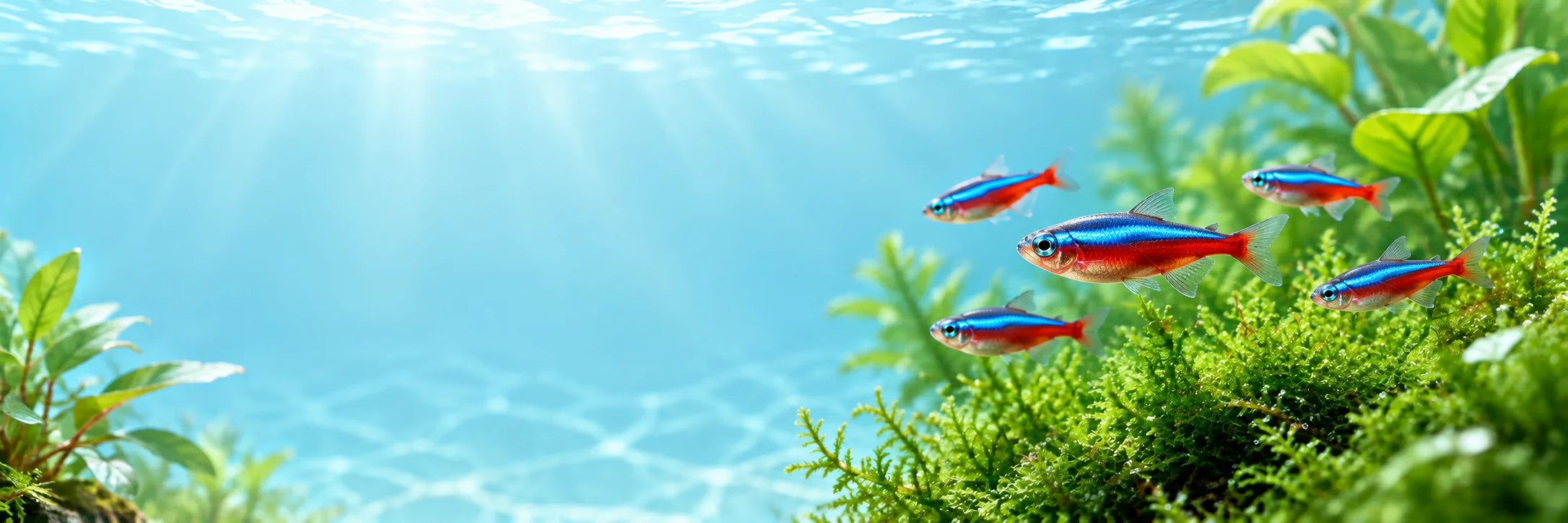
- Neon tetra and cardinal tetra for a mid-water shoal.
- Harlequin rasbora or galaxy rasbora (celestial pearl danio) as an alternative shoal with a different shape.
- Corydoras panda, sterbai or julii working the substrate.
- Kuhli loach — nocturnal, needs sand or smooth gravel and somewhere to hide.
- Dwarf gourami, honey or neon blue, as a centrepiece.
- Platies and swordtails if you want colour that breeds readily.
Larger or higher-character tanks, 150 litres and up
- Pearl gourami — reaches a decent size and holds its own.
- Bristlenose pleco or super red pleco — bring driftwood; they rasp on it and it aids digestion.
- Yoyo loach and clown loach — social, boisterous, and clown loaches get genuinely large over years, so plan for the adult, not the 4 cm juvenile in the bag.
- German blue ram — beautiful, but wants stable warm water and settled tank mates.
The rule people skip
Tetras, rasboras and corydoras are shoaling fish. Six is the working minimum; ten or twelve looks and behaves noticeably better. A group of three will hide, colour down and nip each other, and it is nearly always read as “the fish are sick” when the fish are simply outnumbered.
Before your order lands
Have the tank cycled before the fish arrive — ammonia and nitrite reading zero, nitrate present. A tank set up yesterday is not ready today, no matter how clear the water looks.
When the box arrives, do not tip the bag in. Our acclimation guide walks through the temperature and drip steps in order, and it takes about twenty minutes.
If you would rather see the fish before deciding, our shop is at Unit 15, 2–8 Daniel Street, Wetherill Park NSW 2164, and the same stock is on the shelves.
Frequently asked questions
How many fish can I put in my tank?
Tank size matters less than adult size and activity level. As a rough start: in a cycled 60-litre tank, one small schooling group of 8–10 plus a bottom group of 6 corydoras is comfortable. Work from the adult size of each species, not the size it arrives at.
Do you deliver live fish across Australia?
Yes — orders go Australia-wide, packed with oxygen and covered by our Live Arrival Guarantee. Delivery timing is chosen around the weather so the box is not sitting somewhere hot over a weekend.
Which fish suit a complete beginner?
Endlers, platies, harlequin rasboras and corydoras are forgiving of the small mistakes everyone makes in the first few months. We would leave German blue rams and clown loaches until the tank has been stable for a while.
Can I keep fish with shrimp?
Some, carefully. Small peaceful species like ember tetras, pygmy corydoras and otocinclus generally leave adult shrimp alone, though almost any fish will eat shrimplets. If breeding is the goal, a shrimp-only tank gives far better results.
What if something arrives unwell?
Contact us with photos on the day of arrival. That is what the Live Arrival Guarantee is for, and it is easier to sort out on day one than a week later.
Related: Tetras · Corydoras · Rasboras · Gouramis · Plecos · Algae eaters